

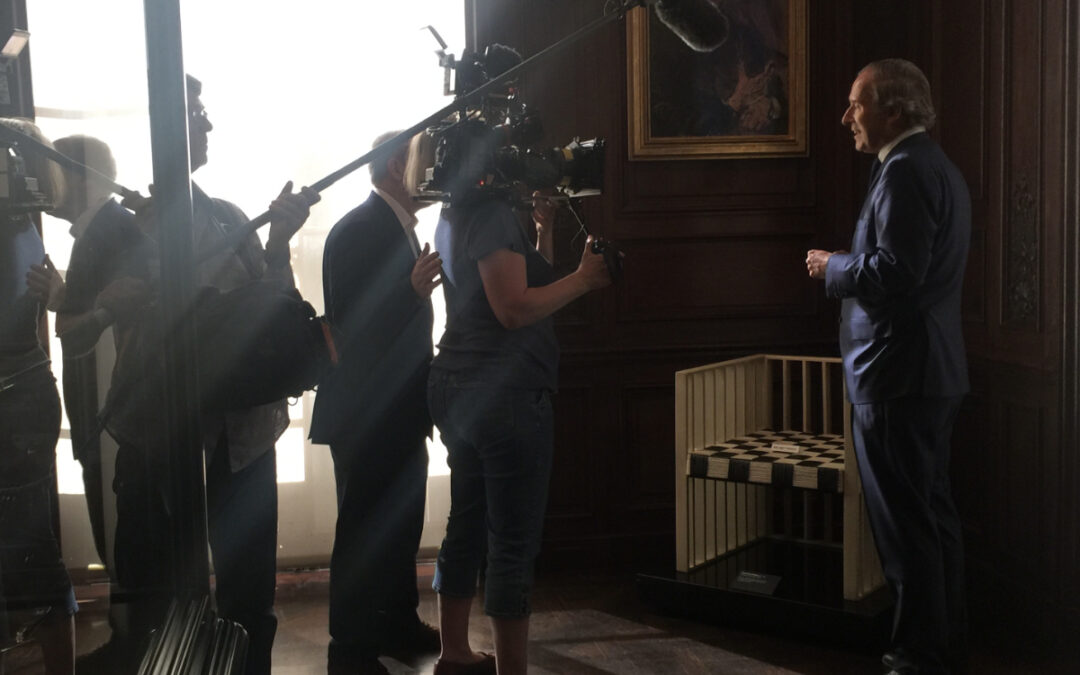
My first look tells me straight away how much space I have to set up in. My second look informs me about the environment’s natural and artificial light sources. Then I check for available power outlets and the breaker box. An important part of checking out the location is to note the color of the walls: White walls will bounce light without shifting the color balance. With white walls, one small light goes a long way.
Next I investigate how the windows could serve as light sources. I take into account cloud patterns and compass orientation to see whether direct sunlight is hitting the set, and make a mental note of how many daylight hours we have left to shoot our segment. I also look out for potential obstruction behind the windows. Be aware of an abundance of bushes, trees and grass, as they will bounce green light into the set.
It’s also vital to see if the windows have shades or curtains that I can adjust. Windows can be gelled with ND when they end up in my setup, but that takes time. I like the silhouette look for some shots, but it has to work for the character and the story you are about to tell. Otherwise I treat windows as a light source that can be blocked out or diffused. A window can be a fill light, a backlight or a key light for short scenes that don’t require lighting consistency over a long period of time. But unless you have greater knowledge of the weather patterns, windows are wild cards that demand extra attention. Once, while on location in Manhattan, I set up the perfect shot for an interview—a soft light on the subject counterbalanced by two windows in the background that gave the scene a beautiful depth—but after a delay in the talent showing up, the weather pattern changed, the sun came out, and I was suddenly back at square one.
The home’s artificial light sources, from overheads and standing lamps to desk lamps and wall-mounted lights, on the other hand, can be controlled. Once I locate the light switches, I see if they have dimmers. Then I choose where to create a pool of darkness. There is mystery in shadows. Any integrated house lights that I leave on can raise the overall ambient light level, which can be useful for filming 360 degree shots. They can also serve to illuminate a room in the far background. Because household bulbs are not balanced to 3200K, I often switch bulbs to color-balanced bulbs and replace others with brighter bulbs from an expendable kit I bring to each shoot. Higher wattage bulbs are an easy way to increase the overall luminance of a place without having to set up lights.
After I have a complete picture of the location, I talk to the director about the approach we’ll take and how much time we have to set up. Together we determine which part of the house is best suited for our project and dive into our day’s work.
Gutes Gelingen!
Claudia Raschke
Director of Photography